2022
Deep Dive is an allegory of digital capitalism’s insatiable desire for personal data and attention. The player’s gaze serves as the primary gameplay mechanism, which, as is revealed as the game progresses, is antagonistically captured by the game’s AI narrator. The game begins with the player in first-person view, seated at a laptop near the shore of a large body of water. The screen asks the player if they wish to “dive into their digital personality.” Upon engaging with this prompt, the player is led towards the shore, where they are invited to take a deep dive and plunge into the waters to encounter their “digital self.”
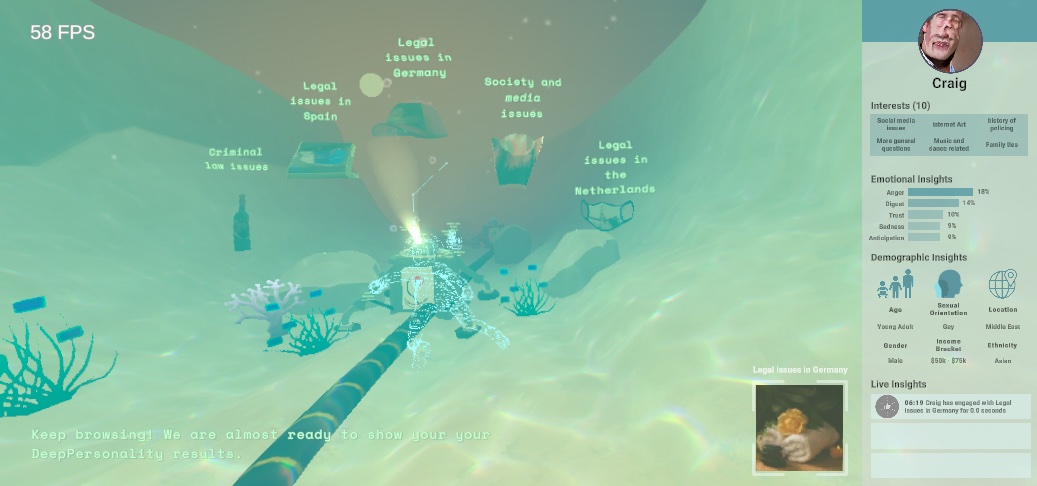
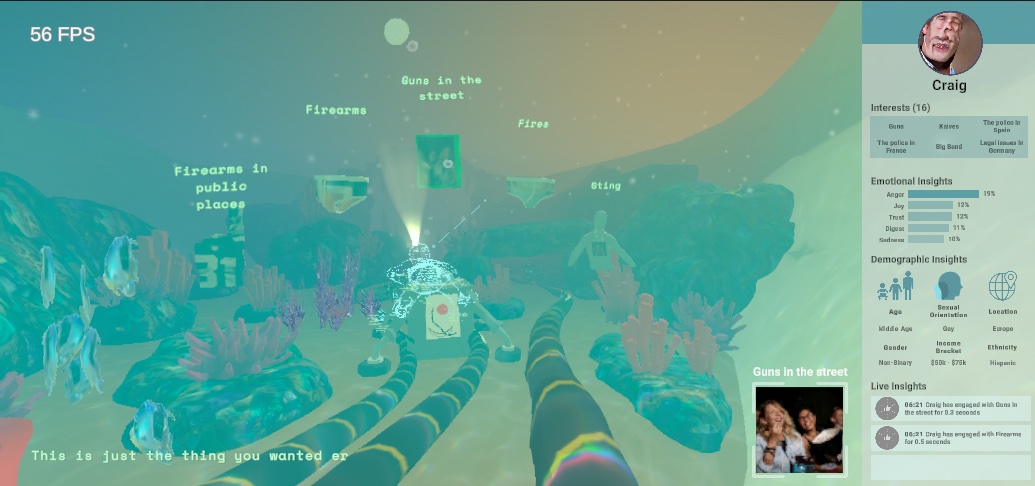
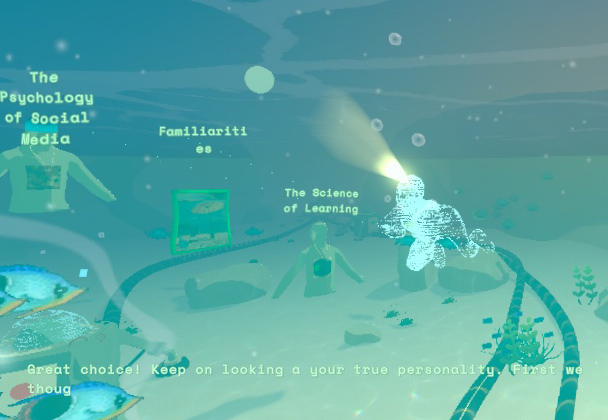
Once underwater, the game shifts into third-person view, revealing the player as a humanlike cloud of data. A submarine internet cable is seen snaking through the undersea environment, with various hubs that branch in different directions. The player controls the character by shifting its gaze with the mouse, leading it towards different objects that emerge from the hubs. The various objects – shirts, yoga mats, cell phone cases, to name a few – are textured with images and labeled to represent specific interests. When the player looks at a given object, their gaze is logged in a user interface to the right of the viewport. The interface reads, for instance, “Craig engaged with Sports for 1.5 seconds.” When the player gazes at an object past a certain threshold, the interface reports that an interest has been logged, which is filed into a visible database. This replicates the mechanisms of platforms like Instagram, which construct detailed profiles on users based on passive gestures such as glances.
Once an interest has been logged, a profile begins to be constructed by the underlying machine learning system, inferring the player’s age, gender, location, emotional state, and other demographic categories. Each subsequent object that the player looks at is logged, and this list of interests is then used to generate further, related objects This mimics the action of algorithmic recommendation systems found on various platforms. These recommended objects become increasingly specific – and increasingly uncanny – as the player continues to engage with content, thereby expanding the dataset representing their behavior. This demonstrates the action of algorithmic “filter bubbles” on platforms like Facebook, which notoriously reproduce individuals’ own interests rather than presenting an objective public sphere. As the player moves through the underwater environment, the GPT-based recommendation system gradually encloses the player, whose freedom of choice is reduced to a narrow set of highly specific topics.
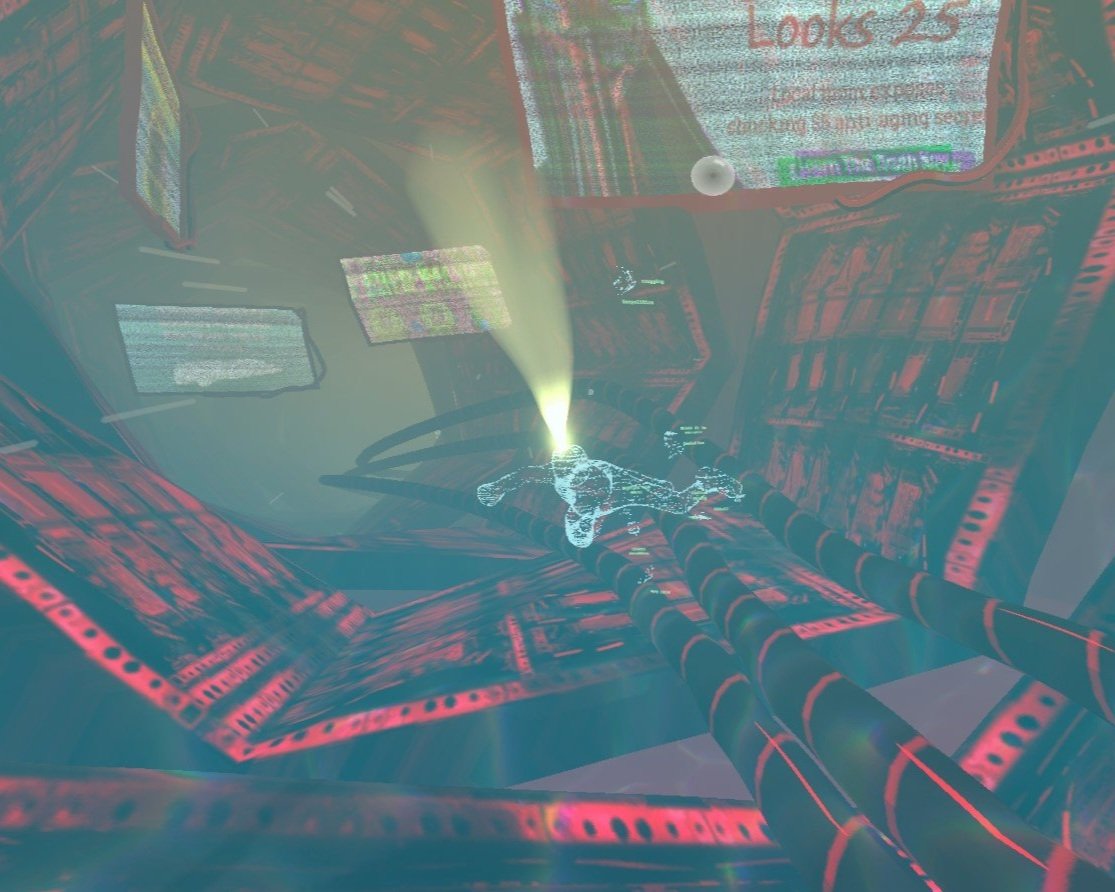
The gameplay escalates into a final stage, which sees the player confronted with a hydra-like assemblage of cables and screens that aggressively attempts to maintain the player’s gaze on recommended content. Once defeated, the player reaches a final adversary – a visualization of a body made of data, which can only be destroyed by solving a series of cryptic prompts reminiscent of the “dark UX” patterns deployed by online services to deceive users into compliance.
Produced in collaboration with Matthew Waddell, Mat Lindenberg and Peter Nichols. Funded through the Canada Council for the Arts' Digital Now initiative.